Every founder’s bottleneck is a silent growth killer. You are here as you’re likely to start running your business to innovate and lead. Yet, you might find yourself trapped in 10 to 15 hours of repetitive tasks every week – ranging from email triaging, calendar management, and CRM updates.
Now, if you are currently researching how to hire a virtual assistant in the Philippines, you have probably identified it as the most cost-effective and culturally aligned talent pool in the world.
In this guide, you’ll discover how to hire a virtual assistant in the Philippines correctly to help you add more scalable engines to your business.
Step 1: Define Your Needs (“Genius Zone” Audit)
Now, before you post any job description or browse a single portfolio, you need to perform an audit of your current workload. When you hire without a roadmap, you just waste capital and end up back where you started.
The key to hiring a Filipino virtual assistant effectively is moving just beyond “general help” and really targeting specific business outcomes.
Now, to help you identify exactly what to delegate, you need to categorize your weekly tasks into these three buckets – this is to make sure you’ll hire for the right skill level and pay for the appropriate market rate:
- Bucket A: Administrative and Repetitive – these include email inbox management, calendar scheduling, travel booking, and data entry.
- Bucket B: Marketing and Growth – includes social media scheduling using tools like Buffer or Hootsuite, basic graphic design (Canva), newsletter formatting, and lead scraping.
- Bucket C: Specialized Operations – tasks include CRM management using tools like HubSpot or Salesforce, video editing, link building, and keyword research in SEO, or technical customer support.
Pro Tip: Spend the next five days recording your screen using tools like Loom or Scribe every time you do a repeatable task. You do it just to narrate what you are doing, and it can also serve as your standard operating procedures (SOPs).
So when you start hiring a VA, you won’t just tell them what to do; you can send them a link to a folder that shows them exactly how you want it to be done.
Step 2: Choose Your Hiring Path (Direct Hiring vs. Managed Services)
Once you’re done with your task list, your next decision in hiring a virtual assistant in the Philippines is choosing between DIY hiring or getting an agency for managed virtual assistant services.
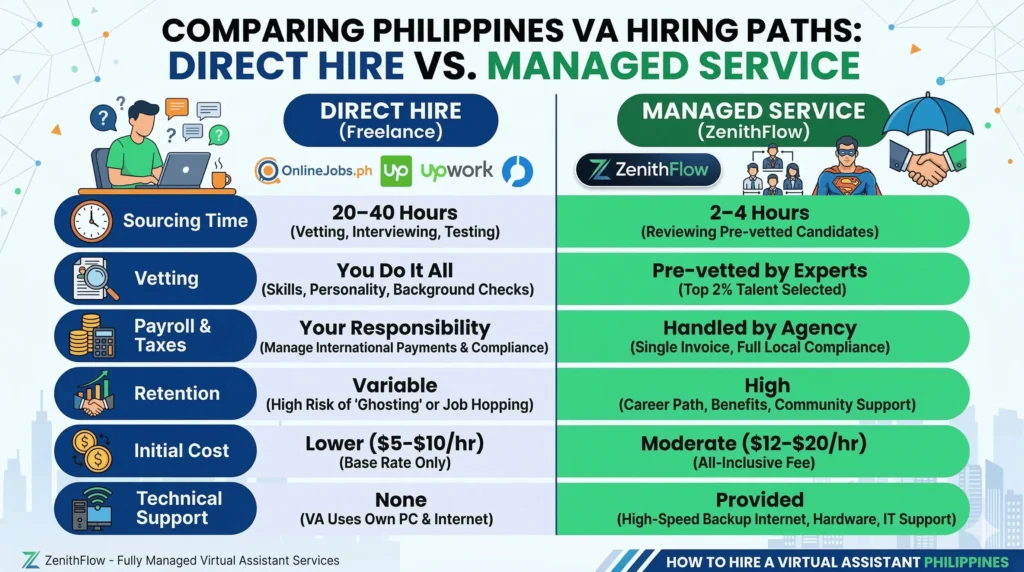
Path A: Direct Hiring (DIY Route)
When you directly hire virtual assistants, you look for them on job boards like OnlineJobs.ph, Upwork, or LinkedIn jobs to find, interview, and hire a freelancer directly on those platforms.
This is ideal and best if you’re a solopreneur who has a very tight budget or is a founder who already has a robust HR system in place. The upside here is its lowest hourly cost and the direct 1-on-1 relationship you have with the virtual assistant.
Conversely, it is time-consuming on your end, given that you must sift through hundreds of resumes and conduct 5 to 10 interviews. It also comes with compliance risk, as you are responsible for navigating Philippine labor laws, 13th-month pay, and international wire transfer for salary payment.
And without any local entity giving that oversight and benefits, the worst thing that can happen to you is that these hired freelancers can leave, even if you offer them a higher-paying gig.
Path B: Managed Service Provider (ZenithFlow Route)
Filipino virtual assistant agencies like ZenithFlow can act as your employer of record. They will recruit, vet, and house the VA, so you can just simply manage the workflow.
Hiring virtual assistant agencies is best for scaling businesses, agencies, and executives who deeply value their time, over a few dollars in hourly savings.
The advantages are higher in count than doing it DIY:
- Vetted talent – you will only interview the top 10% who have already passed skills and personality tests.
- Zero admin – the virtual assistant agency handles all the payroll, Philippines taxes, health insurance (HMO), and equipment.
- Stability – virtual assistants in a managed work environment have higher retention rates, given that they have a local community, development coach, and job security.
The only con here is that it gets you a higher hourly rate compared to direct hiring, due to the management and benefits layer in staffing.
Step 3: Navigate Rates, Compensation, and Philippine Labor Laws
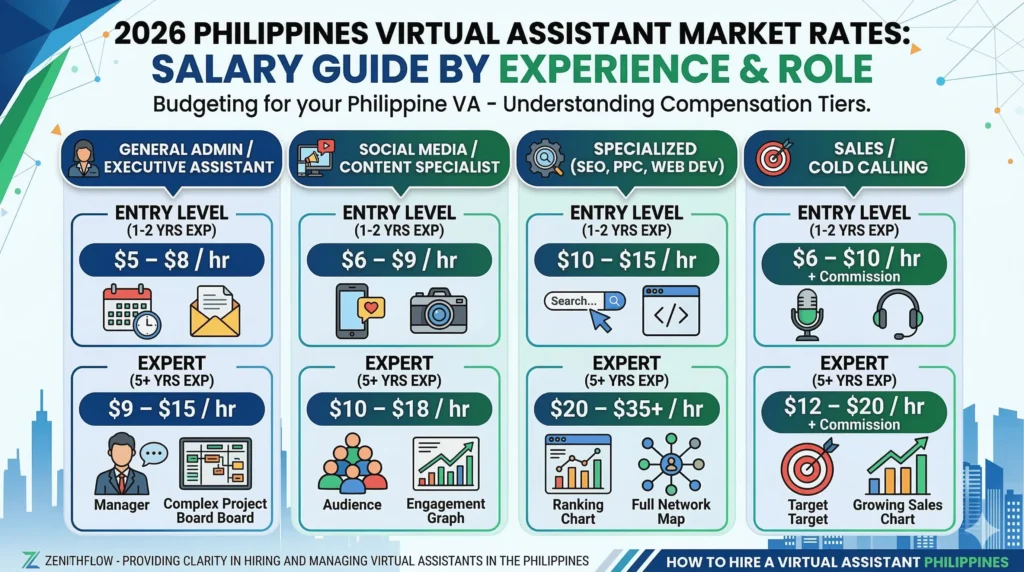
The reality is that budgeting is a critical phase when you hire a virtual assistant in the Philippines. While the cost savings are significant, it’s important to understand the 2026 market rates and some of the hidden costs that come with employing someone from the Philippines.
Fact: Salaries in the Philippines have matured. Others still think that you can find ultra-low-cost labor, but that’s not always the case. You can find the top 2% of talent, especially those who can actually work independently and can really solve complex problems, of which can command higher professional rates.
Hidden Costs of DIY Hiring
When you choose to hire virtual assistants directly, you need to account for several local labor costs that are just standard in the Philippines. Do not ignore these, as they can lead to higher turnover and a poor reputation for your brand in the local talent community.
A couple of things you should consider:
- 13th-month pay – Filipino employees are entitled to an additional month’s salary, which is usually paid in December.
- Holidays – if you’re not aware, the Philippines has one of the highest numbers of public holidays in the world (Regular and Special Non-Working holidays), so you need to decide beforehand if your Filipino VA will work on these days and if you’re willing to pay them holiday pay, which is usually 1.5 to 2 times their daily rate.
- HMO (Health Insurance) – high-level talent, especially in the Philippines, are expecting health insurance, and that’s what makes a direct-hire scenario difficult for Western businesses to provide, as they often require you to send a “stipend” instead.
Managed Service Advantage (Compliance on Autopilot)
One of the primary reasons business owners struggle when hiring a virtual assistant in the Philippines is the administrative burden of international HR.
So when you start to work with agencies that provide virtual assistant services, all these complexities will vanish. The monthly fee comprehensively covers:
- Standardized 13th-month pay accrual
- Government-mandated contributions (SSS, PhilHealth, Pag-IBIG)
- Managed HMO plans that can provide better coverage than just a stipend
Now, regardless of what path you choose, you should avoid the “race to the bottom” on price, as someone who is getting paid at $5 per hour, who just requires 5 hours of your management time per week, is actually more expensive than a $12 per hour VA who truly operates autonomously.
Step 4: Vet for Hiring Success (4-Step Protocol)
Now, a resume only tells 20% of the story. Given that the Philippine VA market is actually highly competitive, top-tier candidates often have optimized resumes just to look good on paper. But to truly find the top 10% of talent, you need to implement a rigorous vetting protocol that certainly tests for competence, character, and consistency.
When you skip these steps, it could be the reason for ghosting or subpar performance when you hire the VA. Here are four things you can test or assess when hiring a virtual assistant in the Philippines.
1. Skill Testing
Before you jump on a Zoom call with your prospective virtual assistant, you should verify the non-negotiables. A couple of things to consider right away:
- Internet speed test – you can ask for a screenshot of their speed test. Now, usually in the Philippines, you get a minimum of 25 Mbps (with a backup connection like a pocket Wi-Fi) as a professional remote working standard.
- English proficiency test – you can use a standardized tool or a short written assessment to make sure their written communication can match your brand voice.
- Specific skill tests – if you opt for hiring a specialized role, you can send a 15-minute test. For instance, in a lead gen VA role, you can ask them to find the email addresses of 5 specific CEOs with defined attributes.
2. Personality and Psychological Profile
It’s true that mindset cannot be taught easily, but skills can be taught. This same principle applies to high-performing virtual assistants in the Philippines. Some tests you can try:
- DISC or Enneagram testing – you can use these tools to see their natural temperament that fits your preferred role (for example: high C for detail-oriented bookkeeping).
- Situation question – during your interview, you can ask “what would you do if your internet went out 10 minutes before a major deadline? – giving you a case answer to see if the applicant is worth hiring.
3. Live Video Interview (“Vibe” Check)
Now, if you prefer a deeper level, you can use video to assess the communication and cultural alignment of your preferred Filipino virtual assistant.
Look for any signs of clarity of speech, background noise (is it a professional environment?), or their ability to actually think on their feet.
Another way is asking about their ownership concern, so you can ask about a time they made a mistake with a previous client and how they were able to handle it. Now, top-tier VAs usually will take ownership. Conversely, lower-tier ones will just blame their client or the work system.
4. Security and Compliance (Background Checks)
Let’s face it, you need security, especially when you’re giving someone access to your CRM or passwords.
So you can actually ask for some reference checks – actually call or email their last two clients, and ask for a quick background check if possible.
Step 5: Onboarding and Long-Term Retention
Now, landing a top-tier candidate is only half the battle. You need to know how to onboard them properly to know your workflow.
And as a good rule of thumb, create a 90-day roadmap for the actual integration of your virtual assistants.
Do not try to overwhelm your new hire on Day 1. You can break the onboarding and integration into digestible phases:
- Day 1–30 (Learning Phase) – start focusing on tool mastery and culture. Your Filipino VA should know how to shadow you on Loom videos and can actually complete low-stakes tasks. Either set up a welcome kit in Notion or Google Drive, which contains all login credentials, brand guidelines, and communication norms.
- Day 31–60 (Collaboration Phase) – start moving from just shadowing to executing. In here, you can provide feedback daily. Use Asana or Trello to assign some tasks with clear deadlines.
- Day 61–90 (Ownership Phase) – your Filipino VA should now suggest improvements to your workflows by shifting from task-tracking to outcome-tracking.
Final Thoughts: Reclaim Your Time Today
When you start hiring a virtual assistant in the Philippines, the single most effective way to scale your operations and especially the founder’s bottleneck, you can no longer just outsource – but actually build a global team designed for growth.
Do not spend 40+ hours just sifting through resumes. Let all the experts handle the heavy lifting.
Book your free strategy call with ZenithFlow. Let our team find your perfect Philippine match and start scaling your business today.
The Author

You may also like
Benefits of Outsourcing in the Philippines [2026 Guide]
The benefits of outsourcing in the Philippines are hard to ignore, given that…
How Much Does a Virtual Assistant Cost in the Philippines?
If you are buried in $15-an-hour tasks while you're still trying to run your…